
I am so glad the Mayans were wrong about the world ending in 2012. Because 2013 has barely begun and it is already far more interesting.
It really isn't every day that a massive chunk of space rock comes tumbling headlong into our atmosphere and explodes. Even more amazing is the fact that the 10,000 ton space rock careened to earth over a populated area and, though injuring many with the massive blast, killed no one. It is enough to make an unbeliever reconsider the concept of guardian angels.
In my mind, however, what was even more amazing about last week was not this natural event but a human and divine one. That would be the now famous address in which Pope Benedict XVI announced his upcoming renunciation of his papal office. It was a stunning move, to say the least. This incidentally occurred on the same day that the Vatican dome was struck by lightning. Twice.
Whether the strike be a sign from God or not (a sign of what we aren't told), it certainly marked a momentous day. No pope in 600 years has abdicated his throne. It would be a first in recent history, at a time when the Catholic Church has reached a critical point in her ad the world's history. Even putting aside the more egregious examples of the mostly secular, mostly political, and mainly awful mainstream media coverage of the entire affair, one theme has emerged in a resoundingly clear crescendo:
The Catholic Church is the only institution left that has not altered its official stance on the issues that dominate the modern world: abortion, contraception, homosexual sex, Marxism and capitalism. For the Church to remain relevant, it MUST CHANGE ITS VIEWS. NOW.
Implicit in that unified outcry is the assumption that the new pope, chosen from a pool of cardinals hand-picked by men who championed against these issues, will do nothing to "move the Church forward." For the journalists, politicians, and activists who are doing the crowing about progressivism in the Church, they couldn't be more right.
Thank God.
Their beef with the Church is really quite silly when you think about it. The Church has been a monument of rock-solid permanence for the past 2,000 years or so. She has seen empires rise and fall, has watched great men flare up and burn out, has born through fierce storms of mankind demanding violence and change. And yet here she still stands, still unmoved by those pleas to alter her first principles. In a way that the secular world is unable to understand, the Church does not change not because she will not, but because she can not. When her identity contains within itself the bearing witness to an unchanging truth, then consequently being untrue to that truth would make her cease to exist. It is just that simple.
But this is only half the silliness of the world's beef with an unchanging Catholic Church. The other half is why the secular world gets its pants into such a collective bind when the Church once again, for example, mildly insists that we will never see women priests. For such an enlightened, reasonable world where democracy reigns supreme and tolerance is the byword of the day, why then is there such a problem with the Catholic Church?
The problem appears to be a simple one of identification. When a man of the modern world devotes himself to secularism, he thinks that he is simply extricating himself from the noxious tangle of religion and belief in God in order to put himself on a higher plane of understanding than the rest of humanity. From this higher plane he can view the world from a truly enlightened angle and judge impartially what is best for it. Reality, sadly for him, is somewhat different. What the secularist does not realize is that on the natural level he can never become a detached observer of his own kind, because he himself is of that kind and probably knows just as little about humanity's ultimate good than any other human. This inevitably will lead him to clash with religion because his imagination has become his own religion.
The Catholic Church, meanwhile, adds another layer to this assessment by giving us the supernatural reason that the secularist has a beef with unchanging truth. Mere men in many ways would not have such a burning hatred of the truth if it were merely they that were engaged in the battle. Leaving each other to believe as they please only works for so long. The Church's unwavering doctrine of Satan and his power are as true today as they have always been, as well as the teaching that the Devil hates humanity with all of his heart and desires to egg them on against the truth with all of his might. So the secularist, in his indifference to truth, becomes its enemy and by default the ally of a host of evil spirits that are engaged in an epic war against said truth.
Author Steve Jalsevac, in an excellent article on LifeSiteNews.com, quotes Vatican observer Robert Moynihan as saying this:
“Are there facts the Pope has weighed in making this decision that we simply don't know about, or don't know fully? … Does the Pope have information about the possible course of events in the months ahead that led him to conclude that he needed to allow a younger, more energetic man to take over his office from him, so that the Church's highest authority could take action quickly and decisively as events unfold?”
I am becoming more and more convinced that Moynihan has hit on something extremely important here. Whether it be the need for stronger discipline of the Church's errant leaders, as Jalsevac suggests later in his piece, or the ominous rising tide of American-style sexual liberation by government coercion, or something else entirely (or all of these things), I am in admiration of a move by Pope Benedict that I think will be perceived only later as the brilliant move that it is. It is a move that I imagine will create a counter-crescendo to the rising cacophony and blathering disunity of secularism.
It is a move of unity, continuity, humility, and permanence.
The new pope (whomever he shall be) will only proclaim one thing, the truth. It shall be the same obnoxiously immovable and unchangeable truth as it always has been, no matter how many or how few people adhere to it. The media loves its facts and figures concerning the average Catholic's attitude towards the Church's teaching; what they fail to realize is that waning church attendance and liberal attitudes about contraception and abortion are not signs of the Church's irrelevance. A drought is not a sign of the irrelevance of rain, but of the desperate and all-encompassing need for it. So it is with the Church and her truth.
God bless Pope Benedict XVI, and bless all the cardinals as they meet to discover which of them shall sit on the throne of Saint Peter next. I will be waiting with baited breath.
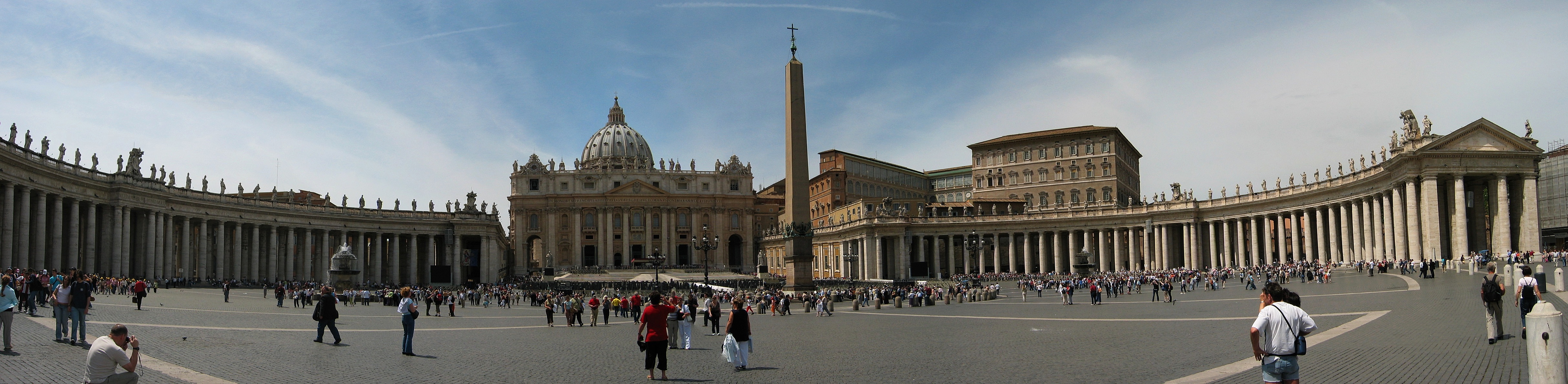
Panorama of St Peter's Square in Vatican City. Photo by François Malan, via Wikipedia.


